
 Tiếng Việt


IBM to Unveil Largest Quantum Computer Yet in 2025, Revolutionizing Technology and Industry
In a remarkable announcement that has garnered significant attention from both the scientific and technological communities, IBM has unveiled its intention to launch the world’s largest quantum computer in 2025. This initiative is a pivotal component of the company’s ambitious roadmap aimed at developing quantum-centric supercomputers, a venture that promises to redefine the landscape of computation and industry innovation.
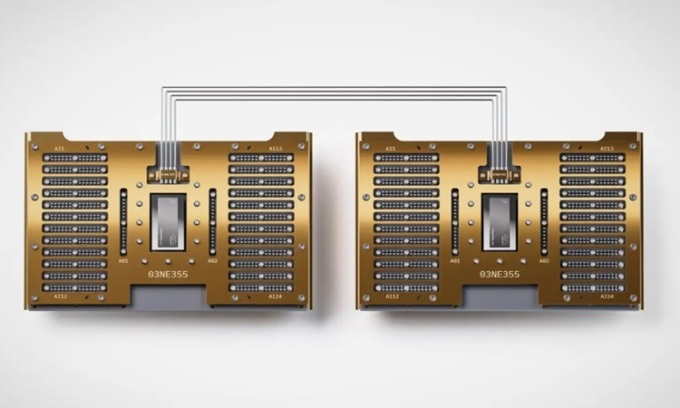
At the heart of this advancement lies IBM’s new quantum computer, which is projected to exceed 4,000 qubits—a substantial leap from existing quantum computing capabilities. The company’s innovative modular design strategy allows for the integration of multiple smaller processors, enabling them to operate cohesively as a more powerful system. This approach effectively addresses critical challenges associated with scaling quantum computers, particularly issues related to qubit coherence and connectivity.

The forthcoming quantum computer will utilize the IBM Quantum System Two architecture, which was unveiled in December 2023. This architecture, already housing the groundbreaking Quantum Heron processors, represents a scalable and upgradeable platform that can adapt to future advancements in quantum processing units (QPUs). Such modularity ensures that IBM’s technology remains flexible and responsive to ongoing breakthroughs in the field.
The implications of this quantum computer are expected to be transformative across various sectors. In healthcare, quantum computing’s capacity to process vast datasets could revolutionize drug discovery and genomics, significantly expediting the development of new treatments and vaccines. In the financial sector, institutions may leverage quantum algorithms to optimize investment strategies, enhance fraud detection, and manage risks with unprecedented precision. Additionally, in logistics and supply chain management, quantum computers could optimize complex networks, yielding more efficient operations and reduced costs—an outcome with substantial ramifications for global trade. Furthermore, artificial intelligence (AI) and machine learning models will benefit from enhanced training capabilities, enabling the development of more sophisticated algorithms and applications.
However, the path to realization is fraught with challenges. The development and deployment of IBM’s quantum computer will necessitate advanced error correction techniques, stable operational environments for qubits, and a skilled workforce for maintenance and programming. Nevertheless, the modular design approach suggests that IBM is well-prepared to tackle these hurdles.
Looking beyond the 2025 milestone, IBM envisions a future where quantum-centric supercomputers address problems that remain unsolvable by classical computers. This evolution is anticipated to drive innovation, bolster global competitiveness, and unlock new avenues for scientific inquiry.
As the countdown to 2025 progresses, the world watches with bated breath. IBM’s quantum computer is not merely a technological achievement; it signifies a paradigm shift in humanity’s approach to complex challenges and opportunities. The unfolding narrative promises to reshape the technological landscape and its myriad applications for years to come.
